To Spot Fake Voices, Look Beyond the Sound, Researchers Say
Researchers at Northwestern University report that fake audio of public figures can be caught more reliably when detectors use simple context and written transcripts, not just the sound itself. Their results point to a practical shift in how tools should flag deepfake voices. This matters as false clips travel fast online and are hard to judge by ear alone.
Why this is in the news
The team worked with more than 70 journalists to assemble a set of 255 known fake clips of public figures, and they created a second set using voices of deceased public figures. They also tested on two large public test sets. Together, these reflect the kinds of recordings that circulate during elections, crises and celebrity news.
The authors’ explanation: a structural flaw
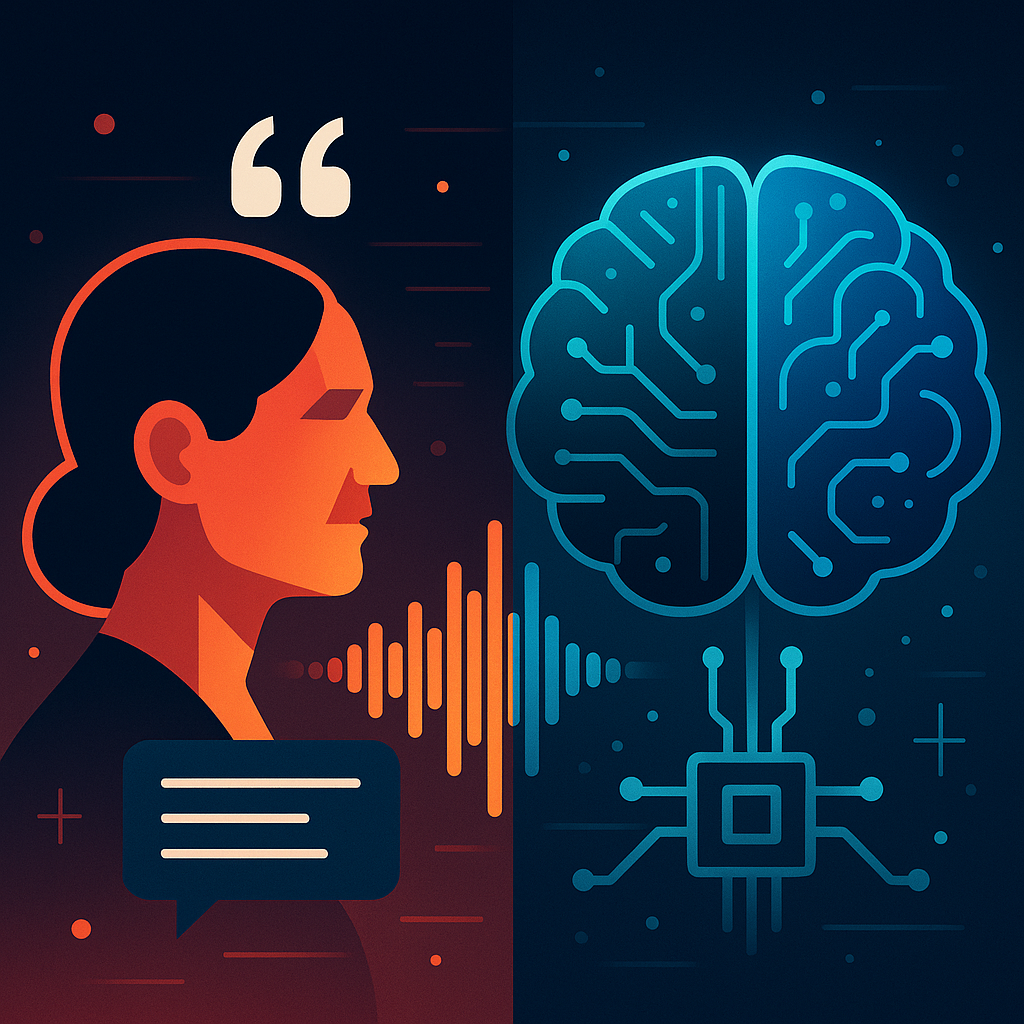
Most current detectors listen only to the audio file. People, in contrast, rely on context: who is speaking, where and when, and whether the words fit the situation. The authors built a context-based detector that can use a transcript (the written words) and basic background signals. Across many tests, detectors that added context or transcripts became markedly more accurate and held up better when fakes were subtly altered to evade detection.
A concrete example: extortion by voice
Imagine a voicemail that sounds like a city official ordering an urgent payment or hinting at legal trouble if it is not made. The voice is convincing. Yet the message cites a meeting that did not occur, uses a title the official does not hold, or refers to a news event before it happened. A system that checks the words and simple facts around the clip is more likely to flag it than one that listens only for audio artefacts.
Main risk: speed and scale
Fake voices can be generated in minutes and spread to millions. Small tweaks to the audio can fool detectors that rely solely on sound. The authors see the larger danger in how quickly public trust can be eroded when false audio appears credible and is hard to debunk in time.
What they propose: controls and checks
Build detectors that combine sound with transcripts and basic context checks. Use journalist-sourced and synthetic datasets to test tools on cases that resemble the real world. Design systems to report uncertainty, resist simple evasion tricks, and keep a human in the loop for sensitive decisions in newsrooms and platforms.
In conclusion
Adding context and transcripts raised accuracy by notable margins and made systems sturdier against attacks in the authors’ tests. The approach will not stop all fakes, but it is a concrete step that helps tools work more like people do—by weighing not just how something sounds, but whether it makes sense.
In short
Checking who, where and what was said—on top of the sound—greatly improves the detection of fake voices.
Key takeaways
- Listening alone is not enough; using transcripts and simple context makes detectors more accurate and robust.
- New journalist-provided and synthetic datasets bring real-world cases into testing.
- Platforms, newsrooms and AI developers should build in context checks, clear uncertainty reporting and human oversight.
Paper: https://arxiv.org/abs/2601.13464v1
Register: https://www.AiFeta.com
deepfakes audiofakes journalism mediatrust AIsecurity NorthwesternUniversity research factchecking moderation